🟢 What it is
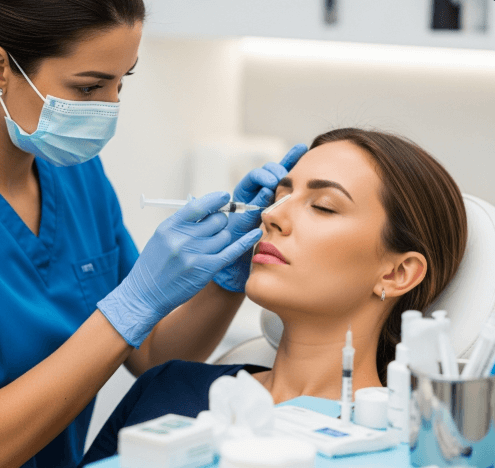
Non-Surgical Rhinoplasty in Korea—also known as a Liquid Nose Job—is a minimally invasive cosmetic treatment that uses dermal fillers (primarily Hyaluronic Acid) to reshape and refine the nose without surgery.
This treatment is ideal for patients who want to:
- Raise a flat or low nose bridge.
- Smooth out small humps or irregularities.
- Lift or refine the nasal tip.
- Improve facial harmony without committing to permanent surgery.
Unlike surgical rhinoplasty, this method does not involve incisions or implants. The results are temporary, reversible, and adjustable, making it a highly popular procedure in Korea, where natural, balanced beauty is the priority.
🟢 Why it’s Done
Non-surgical rhinoplasty is widely sought after in Korea for both aesthetic and practical reasons:
➡️ Quick enhancement: Provides instant results in just minutes.
➡️ No downtime: Patients can return to daily life immediately.
➡️ Subtle reshaping: Defines the nose bridge, tip, or overall profile.
➡️ Non-committal: Allows patients to preview potential changes before considering surgical rhinoplasty.
➡️ Confidence boost: Refines facial proportions, creating balance between the nose, chin, and forehead.
Korean beauty standards emphasize a straight, slim, yet natural nose, making this treatment extremely popular among both locals and international visitors.
🟢 Alternatives
While non-surgical rhinoplasty is effective, alternatives may be considered:
🔹 Surgical Rhinoplasty: Permanent reshaping with implants, bone, or cartilage adjustments.
🔹 Nose Thread Lift: Uses dissolvable threads to lift and support the nose bridge or tip.
🔹 Fat Grafting: Uses patient’s fat for augmentation, though less precise than fillers.
🔹 Makeup Contouring: Temporary visual enhancement using shading and highlighting.
In many Korean clinics, patients begin with fillers or threads before deciding on surgery for a permanent solution.
🟢 Preparation
Proper preparation is key to safe and precise results:
➡️ Consultation: Korean doctors use facial analysis and sometimes 3D imaging to determine the ideal nose proportions.
➡️ Medical history: Patients disclose allergies, autoimmune issues, or previous nose procedures.
➡️ Avoid blood thinners: No aspirin, ibuprofen, alcohol, or fish oil for 3–5 days before.
➡️ Skin care adjustment: Avoid harsh exfoliants or retinoids around the nose prior to treatment.
➡️ Goal setting: Doctors stress realistic expectations, aiming for refinement, not drastic alteration.
🟢 How it’s Done
The procedure usually takes 15–30 minutes and involves the following steps:
- Cleansing & sterilization of the nose and surrounding skin.
- Numbing: Topical anesthetic or fillers containing lidocaine for comfort.
- Injection technique:
- Bridge enhancement – Filler is injected along the dorsum to raise and straighten.
- Tip refinement – Small filler injections refine or subtly lift the nasal tip.
- Irregularity correction – Smooths out bumps or asymmetries.
- Molding & shaping: Doctor carefully sculpts the filler for symmetry and balance.
- Final assessment: Nose is checked from multiple angles to ensure harmony.
Korean doctors often use blunt cannulas for improved safety and reduced bruising.
🟢 Recovery
Recovery is minimal compared to surgery:
🔹 Downtime: Most patients resume normal activities immediately.
🔹 Swelling: Mild, usually resolving within 1–3 days.
🔹 Bruising: Possible but less common with cannula use.
🔹 Results: Visible right away, with final shape settling in 1–2 weeks.
✅ Post-care in Korea includes:
- Avoid pressing the nose or wearing heavy glasses for a few days.
- No saunas, alcohol, or strenuous exercise for 24–48 hours.
- Ice compress for swelling if needed.
- Sun protection with sunscreen.
🟢 Complications
Non-surgical rhinoplasty is safe when performed by experts, but the nose is a high-risk vascular area:
⚠️ Mild side effects:
- Swelling, redness, tenderness.
- Temporary unevenness.
⚠️ Rare but serious risks:
- Vascular occlusion → blockage of blood flow, possibly leading to skin necrosis.
- Blindness risk if filler enters vessels connected to the eyes.
- Overfilling that looks unnatural.
- Migration of filler over time.
➡️ Korean clinics minimize risks by using ultrasound guidance, micro-dosing, blunt cannulas, and hyaluronidase (enzyme that dissolves HA fillers) for emergencies.
🟢 Treatment Options in Korea
Korea is a global leader in non-surgical rhinoplasty techniques, offering advanced filler technology and artistic injection methods.
🔹 Popular filler brands used in Korea for nose shaping:
- Korean: Revolax, Yvoire, Replengen, Neuramis, Dermalax.
- Global: Restylane Lyft, Juvederm Voluma, Teosyal Ultra Deep.
🔹 Approaches commonly used:
- Bridge definition: Lifts and straightens a low or flat bridge.
- Tip refinement: Subtle reshaping and slight projection of the nasal tip.
- Profile balancing: Smooths out humps and improves side profile.
- Combination correction: Often paired with chin filler for full facial balance.
🟢 Final Thoughts
Non-Surgical Rhinoplasty in Korea is a safe, fast, and highly effective alternative to surgical rhinoplasty for individuals seeking subtle yet impactful nose enhancements.
➡️ Best for those with low bridges, small irregularities, or mild tip concerns.
➡️ Results are instant, customizable, and reversible, making it especially attractive to patients hesitant about permanent surgery.
➡️ With Korea’s advanced filler products, precision injection methods, and natural-focused beauty philosophy, patients can expect elegant improvements that harmonize with their overall facial features.
In summary: Non-surgical rhinoplasty in Korea is a minimally invasive, customizable, and natural-looking option, offering facial refinement without the risks or downtime of traditional surgery.