
What it is
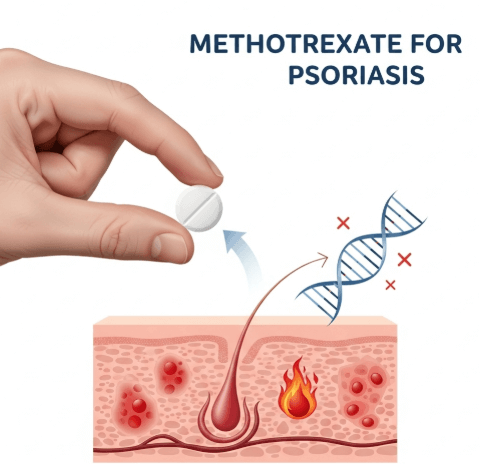
➝ Methotrexate is an immunosuppressant and anti-metabolite medication originally developed for cancer treatment but widely used in dermatology for moderate to severe psoriasis.
➝ Psoriasis is a chronic autoimmune skin condition where the immune system triggers rapid skin cell turnover, leading to plaques, scaling, redness, and itching. Methotrexate helps by slowing down cell growth and suppressing overactive immune responses.
➝ Unlike topical creams or light therapy, methotrexate is a systemic medication, meaning it works throughout the body.
Why it’s done
→ Prescribed for patients with severe psoriasis who do not respond to topical treatments or phototherapy.
→ Helps manage psoriatic arthritis, which causes joint pain and stiffness in some psoriasis patients.
→ Effective in reducing large body surface area plaques, nail psoriasis, and scalp psoriasis.
→ Often chosen for long-term control when flare-ups are frequent and affect quality of life.
→ In Korea, methotrexate is used as a standard systemic therapy, often before moving to biologic drugs.
Alternatives
→ Topical treatments: Corticosteroids, vitamin D analogs, coal tar, and calcineurin inhibitors.
→ Phototherapy: Narrowband UVB or PUVA therapy to reduce plaque thickness.
→ Other systemic drugs:
- Cyclosporine: Suppresses immune activity but can affect kidney function.
- Acitretin: An oral retinoid helpful for certain resistant cases.
→ Biologics: Injections targeting specific immune pathways (e.g., TNF-alpha inhibitors, IL-17, IL-23 blockers).
→ Lifestyle approaches: Stress management, diet modifications, and skincare routines.
Preparation
→ Patients must undergo blood tests (liver function, kidney function, complete blood count) before starting.
→ Screening for hepatitis B, hepatitis C, and tuberculosis is often recommended to avoid hidden infections.
→ Alcohol intake should be limited or avoided due to the risk of liver damage.
→ Women should avoid methotrexate during pregnancy, and both men and women are advised to use contraception while taking the drug, as it may cause birth defects.
→ A dermatologist may prescribe folic acid supplements to reduce side effects like nausea, mouth sores, and fatigue.
How it’s Done
→ Methotrexate can be taken orally in tablet form or via subcutaneous injection.
→ Dosing is usually once weekly rather than daily, which is unusual compared to many other medications.
→ The weekly dose may be split into two or three smaller doses taken 12 hours apart to reduce side effects.
→ Regular monitoring through blood tests every 1–3 months is necessary to track organ function.
→ In Korea, clinics often provide structured methotrexate programs, including patient education and follow-up systems.
Recovery
→ Improvement may be visible after 4–8 weeks, but full effects often require 3–4 months.
→ Psoriasis symptoms such as scaling and redness gradually reduce, leading to clearer and smoother skin.
→ Patients often report improved confidence, social interactions, and daily comfort.
→ Regular dermatology check-ups are important for dose adjustments and monitoring long-term safety.
→ If discontinued, psoriasis may return, so doctors typically plan for long-term management strategies.
Complications
→ Short-term side effects: Nausea, fatigue, headaches, mouth sores, and mild hair thinning.
→ Serious risks:
- Liver toxicity (fatty liver, cirrhosis if used long term without monitoring).
- Bone marrow suppression, leading to anemia, low white blood cells, or low platelets.
- Increased susceptibility to infections due to immune suppression.
- Lung inflammation (rare but serious).
→ Contraindications: Pregnancy, breastfeeding, active liver disease, chronic alcohol use, or immunodeficiency.
→ With regular monitoring and professional supervision, most patients tolerate methotrexate well.
Treatment Options in Korea
→ Korea has well-established dermatology centers that specialize in systemic psoriasis treatments, including methotrexate.
→ Doctors in Korea often follow international guidelines but adapt them to local patient needs and the availability of combination therapies.
→ Methotrexate is frequently prescribed as a first-line systemic therapy before shifting to costly biologics.
→ Korean clinics often integrate methotrexate with complementary skin treatments, like moisturizing programs, UV therapy, and herbal skincare regimens, to enhance outcomes.
→ Patient education and lifestyle guidance are emphasized, ensuring patients understand the importance of liver safety, alcohol avoidance, and pregnancy precautions.
→ Many hospitals in Korea provide multidisciplinary care, including rheumatologists for psoriatic arthritis, nutritionists for diet guidance, and psychologists for mental health support.