What it is
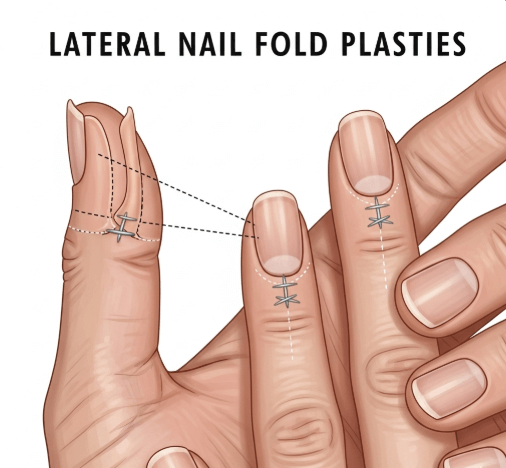
Lateral nail fold plasties in Korea are surgical procedures performed to correct chronic or recurrent ingrown toenails (onychocryptosis) by reshaping the soft tissue surrounding the nail.
Instead of removing only part of the nail (as in partial nail avulsion), this procedure involves excising or repositioning the lateral nail fold to widen the nail groove, reducing pressure and preventing future ingrowth.
→ In Korea, lateral nail fold plasties are performed in dermatology, podiatry, and minor surgery clinics, especially for patients with severe, recurrent, or complicated ingrown nails.
• The focus is on functional correction, pain relief, and cosmetic restoration.
• Considered more permanent and definitive than repeated nail avulsions.
Why it’s done
Patients in Korea undergo lateral nail fold plasties for:
→ Chronic ingrown toenails → When conservative or avulsion treatments fail.
→ Severe pain or infection → To eliminate recurring inflammation.
→ Cosmetic concerns → To restore the natural shape of the toe.
→ Functional improvement → Prevents difficulty in walking or wearing shoes.
→ Long-term solution → Reduces recurrence compared to simpler procedures.
Alternatives
Other treatments for ingrown toenails include:
• Conservative care → Warm soaks, cotton packing, nail braces.
• Partial nail avulsion with matricectomy → Removes the ingrown nail edge permanently.
• Total nail avulsion → Removes the entire nail, usually as a last resort.
• Laser matricectomy → Destroys part of the nail matrix with CO₂ or diode lasers.
→ Lateral nail fold plasties are chosen when soft tissue deformity is the main cause of recurrence.
Preparation
Before undergoing lateral nail fold plasties in Korea, preparation steps include:
- Clinical evaluation → Doctor assesses nail anatomy, infection, and recurrence history.
- Imaging or dermoscopy (optional) → For detailed visualization of the nail fold.
- Medical review → Check for diabetes, vascular disease, or healing disorders.
- Anesthesia planning → Digital nerve block with lidocaine for complete numbness.
- Informed consent → Explanation of scar, healing time, and cosmetic outcomes.
→ Korean clinics often provide 3D imaging or visual models to help patients understand expected results.
How it’s done
Lateral nail fold plasties in Korea follow structured surgical steps:
- Anesthesia → Digital block applied to numb the toe.
- Incision → A wedge-shaped section of the lateral nail fold (skin and soft tissue) is excised.
- Reshaping → The groove is deepened, and tissue pressure on the nail plate is reduced.
- Closure → Sutures are placed to reconstruct a smoother, wider nail groove.
- Dressing → Sterile bandage and antibiotic ointment applied.
→ Variations include:
- Winograd procedure → Removes both nail edge and part of the nail matrix.
- Vandenbos procedure → Removes excess nail fold tissue without touching the nail.
→ The surgery usually takes 30–45 minutes per toe.
Recovery
Recovery after lateral nail fold plasties in Korea is moderately quick:
• Pain relief → Immediate improvement, though mild soreness lasts a few days.
• Stitch removal → Usually in 10–14 days.
• Healing time → Full recovery within 3–6 weeks.
• Activity restrictions → Avoid running, tight shoes, or trauma during early healing.
• Cosmetic outcome → A more natural-looking and pain-free nail fold.
→ Patients can usually walk within 1–2 days but must protect the toe until stitches are removed.
Complication
While generally safe, possible risks include:
- Infection → Prevented with antibiotics and wound care.
- Scarring → Minimal if done precisely; hypertrophic scars are rare.
- Recurrence → Lower than avulsion procedures but still possible.
- Delayed healing → More common in diabetic or vascular-compromised patients.
- Nail deformity → Rare, but can occur if matrix is damaged.
→ Korean specialists reduce risks by using refined surgical techniques and scar care programs.
Treatment option in Korea
Korea offers advanced lateral nail fold plastic surgeries for ingrown toenails:
→ Dermatology and podiatry clinics → Experienced in both functional and cosmetic outcomes.
→ Plastic surgery integration → Especially for patients concerned with scar appearance.
• Laser-assisted procedures → Some clinics combine CO₂ lasers for tissue removal and better healing.
• Scar management programs → Fractional laser, silicone gel, or LED therapy often included post-op.
• Medical tourism → Patients from abroad seek Korean expertise due to its blend of surgical precision and aesthetic refinement.
→ With its high success rate, reduced recurrence, and focus on natural results, lateral nail fold plasties in Korea are one of the most effective solutions for stubborn ingrown toenails.