What it is
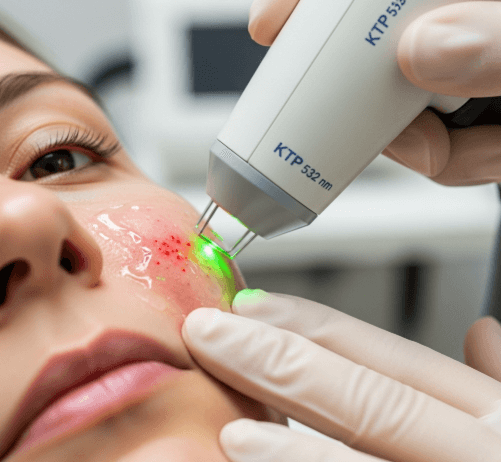
➝ The KTP 532 nm laser (potassium titanyl phosphate) is a vascular laser that emits green light at 532 nanometers, strongly absorbed by oxyhemoglobin in blood vessels.
➝ It is used to selectively target and coagulate superficial blood vessels, making it highly effective for facial telangiectasia, diffuse redness, spider angiomas, rosacea-related veins, and post-surgical vascular marks.
➝ In Korea, KTP lasers are widely available in dermatology, laser medicine, and cosmetic clinics, often combined with other vascular or pigment lasers for comprehensive facial rejuvenation.
Why it’s done
→ To improve cosmetic appearance by reducing visible facial veins, redness, and broken capillaries.
→ To treat rosacea-associated telangiectasia, which is resistant to topical therapy alone.
→ To remove angiomas or vascular spots with precision and minimal downtime.
→ To provide a non-invasive alternative to sclerotherapy for small superficial facial veins.
→ In Korea, patients often undergo KTP laser as part of skin toning and rejuvenation packages for even skin tone.
Alternatives
→ Pulsed dye laser (PDL, 585–595 nm) – deeper penetration, also used for vascular lesions.
→ Nd:YAG laser (1064 nm) – preferred for deeper or larger-caliber vessels.
→ Intense pulsed light (IPL) – broader spectrum, less selective, but effective for diffuse redness.
→ Sclerotherapy – not recommended for delicate facial vessels.
Preparation
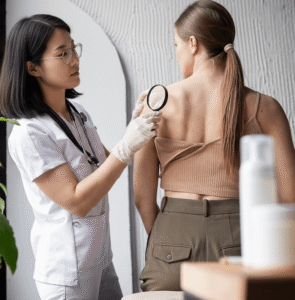
→ Full facial assessment, identifying telangiectasia, diffuse erythema, and focal angiomas.
→ Avoid tanning, retinoids, or photosensitizing medications before treatment.
→ Cleanse skin thoroughly; topical anesthetic is usually unnecessary as KTP laser discomfort is mild.
→ In Korea, clinics often use digital vascular imaging and dermoscopy for baseline records.
How it’s Done
→ A handheld KTP laser device delivers short pulses of 532 nm light to the targeted vein.
→ Parameters: pulse duration 1–20 ms, fluence adjusted for vessel size, spot size 1–3 mm.
→ The green light is absorbed by hemoglobin, causing selective photothermolysis and vessel closure.
→ Cooling systems or chilled air are applied to reduce discomfort and protect the epidermis.
→ Sessions typically last 15–30 minutes depending on extent of facial veins.
→ Most patients require 1–3 sessions at 4–6 week intervals.
Recovery
→ Mild redness and swelling for 24–48 hours.
→ Temporary darkening of treated vessels before they fade over 1–2 weeks.
→ Makeup can usually be applied the next day.
→ Patients typically see significant reduction after the first session, with best results after a series.
Complications
→ Transient hyperpigmentation or hypopigmentation, especially in darker skin types.
→ Blistering or scabbing if excessive fluence is used.
→ Matting or recurrence of telangiectasia with repeated sun exposure or rosacea flares.
→ Rare scarring if improperly performed.
Treatment Options in Korea
→ Korean dermatology and cosmetic clinics use KTP 532 nm lasers widely for rosacea, facial veins, and redness correction.
→ Often combined with PDL or Nd:YAG lasers for multi-depth vascular treatment.
→ Integrated into “skin toning” programs, pairing vascular treatment with pigment lasers (Q-switched Nd:YAG) for overall complexion improvement.
→ Clinics emphasize strict photoprotection after treatment, prescribing sunscreens and soothing creams.
→ Many Korean centers use AI-based skin imaging to objectively measure vascular reduction across sessions.
→ With Korea’s advanced laser dermatology infrastructure, patients receive safe, effective, and cosmetically superior outcomes for facial vein treatment.