What it is
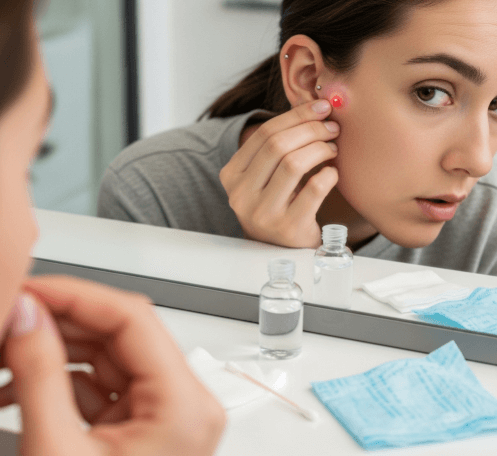
Helix piercing bump care in Korea refers to the treatment and management of small raised bumps that form around cartilage piercings in the ear’s upper rim (helix).
These bumps may be:
→ Hypertrophic scars → Raised but confined to the piercing site.
→ Keloids → Larger, extending beyond the piercing hole.
→ Irritation bumps → Caused by pressure, trauma, or allergic reaction to jewelry.
• In Korea, helix piercing bump care is offered in dermatology clinics, ENT centers, and specialized piercing-friendly medical facilities.
• The focus is on reducing inflammation, flattening the bump, and preventing recurrence while preserving ear aesthetics.
Why it’s done
Patients in Korea seek helix piercing bump care for several reasons:
→ Aesthetic restoration → Bumps distort the smooth cartilage line of the ear.
→ Discomfort → Bumps may cause itching, tenderness, or pressure pain.
→ Prevention of worsening → Untreated bumps may grow into keloids.
→ Jewelry use → Patients often want to continue wearing earrings without scar interference.
→ Confidence → Smooth, natural-looking ears improve appearance and self-esteem.
Alternatives
At-home or alternative care methods include:
• Saline soaks → Daily cleaning with sterile saline to reduce irritation.
• Chamomile compresses → Mild anti-inflammatory effect.
• Over-the-counter scar gels → May help soften bumps.
• Changing jewelry → Switching to titanium or surgical steel to avoid allergic reactions.
→ While helpful for mild irritation bumps, professional treatment in Korea is preferred for persistent or large scars.
Preparation
Before starting helix piercing bump care in Korea, patients undergo preparation:
- Dermatology evaluation → To distinguish between hypertrophic scar, keloid, or irritation bump.
- Medical history → Includes allergies, keloid tendency, and past scar treatments.
- Jewelry removal/change → Switching to hypoallergenic studs if necessary.
- Skincare adjustment → Avoid irritants (alcohol cleansers, harsh antiseptics).
→ Korean clinics often emphasize early intervention to prevent bumps from becoming keloids.
How it’s done
Helix piercing bump care in Korea involves a mix of medical and supportive treatments:
- Topical and local care
- Prescription ointments (antibiotic or anti-inflammatory) for infection or irritation.
- Silicone gels or patches to flatten scars.
- Steroid injections
- Triamcinolone injections every 4–6 weeks to shrink hypertrophic scars or early keloids.
- Laser therapy
- Pulsed dye laser (V-beam) to reduce redness.
- Fractional CO₂ laser to smooth scar tissue.
- Cryotherapy
- Freezing therapy for small bumps, often combined with injections.
- Surgical removal
- For larger keloids, excision may be done, followed by steroid injections or pressure earrings to prevent regrowth.
- Aftercare
- Saline cleaning, hypoallergenic jewelry, and sun protection are emphasized.
→ Treatments are often combined and repeated over several months for best results.
Recovery
Recovery after helix piercing bump treatment is generally straightforward:
• After injections → Mild soreness or redness for 1–2 days.
• After laser therapy → Temporary redness or sensitivity for 2–3 days.
• After surgery → Stitches removed after 7–14 days; scar management continues for months.
• Daily care → Ongoing use of scar gels and saline soaks.
→ Most patients notice improvement within 4–8 weeks, with full results over 3–6 months.
Complication
Possible complications of helix bump care include:
- Recurrence → Common with cartilage keloids unless multiple treatments are combined.
- Pigmentation changes → Darkening or lightening of treated skin.
- Infection → More likely if jewelry is reinserted too soon.
- Cartilage damage → Rare, but possible with aggressive surgery.
→ Korean clinics minimize risks by using stepwise, multi-modal treatments.
Treatment option in Korea
Korea is globally recognized for its advanced ear piercing bump management:
→ Dermatology and ENT clinics → Use precise protocols for scar and cartilage care.
→ Laser excellence → V-beam and fractional CO₂ lasers are widely available for scar control.
• Combination therapies → Surgery, steroid injections, pressure earrings, and laser often combined for resistant bumps.
• Aftercare kits → Clinics provide scar gels, silicone patches, and instructions for saline cleansing.
• Medical tourism → Many international patients seek Korean care for cartilage-related piercing bumps, given the country’s strong scar management reputation.
→ With cutting-edge treatments, holistic aftercare, and aesthetic precision, helix piercing bump care in Korea achieves smoother ear contours, reduced recurrence, and restored confidence.