What it is
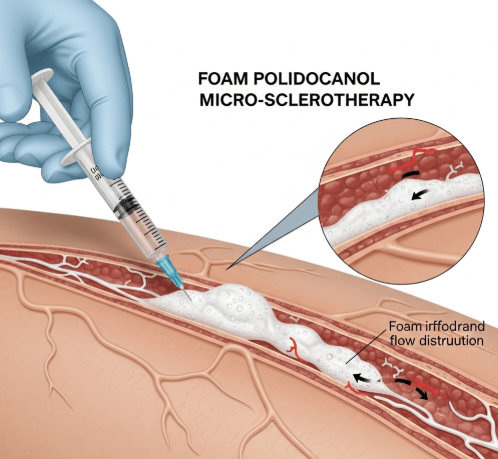
➝ Polidocanol is a chemical sclerosant that damages the endothelium of veins, leading to fibrosis and vessel closure.
➝ In foam micro-sclerotherapy, polidocanol is mixed with air or CO₂ to form a fine foam, which increases the surface contact with the vessel wall and displaces blood for greater efficacy.
➝ This method is highly effective for reticular veins (1–3 mm) and spider veins (telangiectasias <1 mm).
➝ In Korea, foam polidocanol micro-sclerotherapy is performed in dermatology, phlebology, and cosmetic vein clinics, often as part of combined vein treatment programs with lasers.
Why it’s done
→ To improve cosmetic appearance of the legs by eliminating unsightly spider and reticular veins.
→ To provide a minimally invasive outpatient procedure with high success rates.
→ To treat veins that are too small for surgical interventions but too large for superficial lasers alone.
→ To complement laser therapies for optimal clearance in resistant or feeder vessels.
Alternatives
→ Nd:YAG 1064 nm laser: effective for reticular and some spider veins, but painful for larger networks.
→ KTP 532 nm or PDL: best for very superficial facial telangiectasias, less effective on leg veins.
→ Surgical vein stripping or endovenous ablation: reserved for large varicose veins, not cosmetic spider veins.
→ Compression stockings: supportive care, prevent recurrence but don’t eliminate visible veins.
Preparation
→ Full vein assessment, often with Doppler ultrasound to exclude underlying venous insufficiency.
→ Avoid aspirin, NSAIDs, or anticoagulants before procedure (if medically safe).
→ Do not apply creams, lotions, or oils to legs on treatment day.
→ In Korea, many vein clinics provide digital vein mapping and photography before treatment for progress tracking.
How it’s Done
→ Polidocanol (0.25–1% for spider veins; 1–3% for reticular veins) is mixed with room air or CO₂ using the Tessari method to create a stable foam.
→ A fine needle (30–32 gauge) is inserted into the target vein.
→ Foam is injected slowly, filling and displacing blood from the vein lumen.
→ The vein wall collapses, and over weeks, the body resorbs it.
→ Multiple veins can be treated in a single session, usually 20–60 minutes.
→ Post-treatment compression stockings are applied for 1–2 weeks.
Recovery
→ Mild redness, swelling, or bruising may occur at injection sites.
→ Treated veins darken before fading over 2–8 weeks.
→ Most patients resume normal activities immediately but should avoid vigorous exercise, hot baths, and sun exposure for several days.
→ Typically 1–3 sessions are needed for optimal cosmetic results.
Complications
→ Hyperpigmentation along treated veins (common, usually fades over months).
→ Matting (fine new vessels around treated area).
→ Superficial thrombophlebitis in treated vessels.
→ Rare but serious: arterial injection or embolism (extremely rare in experienced hands).
→ Allergic reactions are uncommon with polidocanol compared to older sclerosants.
Treatment Options in Korea
→ Foam polidocanol micro-sclerotherapy is offered in specialized vein clinics and dermatology hospitals across Korea.
→ Often combined with Nd:YAG laser for resistant or feeder veins, giving a dual approach.
→ Compression therapy is strongly emphasized post-procedure to optimize results and reduce recurrence.
→ Korean clinics frequently use advanced foam preparation techniques to ensure consistent bubble size and safety.
→ Cosmetic dermatology centers integrate sclerotherapy with skin rejuvenation and vascular laser programs for comprehensive leg aesthetics.
→ With Korea’s strong emphasis on cosmetic outcomes, foam polidocanol sclerotherapy is regarded as a gold-standard minimally invasive treatment for spider and reticular veins, balancing safety, efficacy, and patient satisfaction.