What it is
Excisional biopsy in Korea is a diagnostic surgical procedure in which an entire skin lesion or lump is completely removed for laboratory analysis.
Unlike shave or punch biopsies, which take only part of a lesion, excisional biopsy removes the full depth and borders of the suspicious area, making it the gold standard for diagnosing melanoma and other cancers where margins are important.
→ In Korea, excisional biopsies are performed by dermatologists, plastic surgeons, or oncologic surgeons in hospitals and specialized skin cancer centers.
• Typically used for pigmented moles, suspected melanomas, basal cell carcinoma, and squamous cell carcinoma.
• The excised tissue is analyzed in pathology labs to confirm diagnosis and determine treatment.
Why it’s done
Patients in Korea undergo excisional biopsy for:
→ Skin cancer diagnosis → Especially when melanoma is suspected.
→ Full lesion removal → Ensures that the entire suspicious growth is studied.
→ Margin assessment → Determines if abnormal cells extend beyond the lesion.
→ Therapeutic benefit → Sometimes the excision itself cures small cancers by removing them entirely.
→ Preventive care → Korea’s emphasis on early detection leads to frequent excisional biopsies for atypical moles.
Alternatives
Depending on the lesion and purpose, alternatives include:
• Shave biopsy → For superficial or non-pigmented lesions.
• Punch biopsy → For sampling deeper skin conditions without full excision.
• Incisional biopsy → Removes only part of a large lesion.
• Fine needle aspiration → For subcutaneous nodules, not skin cancers.
→ Excisional biopsy is preferred when full removal and margin evaluation are essential.
Preparation
Before undergoing excisional biopsy in Korea, preparation involves:
- Dermatology consultation → Examination with dermoscopy or imaging.
- Medical history → Allergies, bleeding risks, medications (blood thinners).
- Informed consent → Patients are briefed on scar formation, healing time, and pathology follow-up.
- Local anesthesia planning → Lidocaine is injected at the biopsy site.
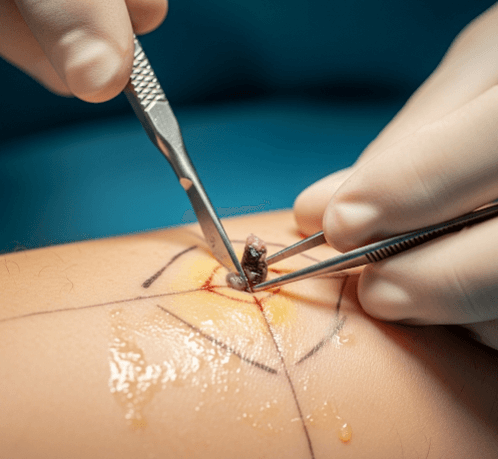
- Skin marking → Surgeons mark the excision line to ensure clear margins and good cosmetic outcome.
How it’s done
Excisional biopsy in Korea is performed as an outpatient procedure:
- Anesthesia → Local injection numbs the area.
- Elliptical incision → A scalpel removes the lesion along with a small margin of normal skin.
- Tissue collection → The sample is preserved in formalin and sent for pathology.
- Wound closure
- Sutures are placed in layers for neat healing.
- Dissolvable or non-dissolvable stitches may be used.
- Dressing → Antiseptic ointment and bandages protect the site.
→ The procedure takes 20–40 minutes, depending on lesion size and location.
Recovery
Recovery after excisional biopsy is generally smooth:
• Healing time → 1–3 weeks, depending on the wound size.
• Stitch removal → Usually after 5–14 days.
• Scar appearance → Typically a fine line; Korean clinics often provide scar care therapies.
• Aftercare → Keep the wound clean, apply ointment, and avoid excessive stretching of the area.
• Sun protection → Prevents scar darkening and pigmentation changes.
→ Most patients resume normal activities immediately, with restrictions on heavy exercise until stitches are removed.
Complication
Possible risks include:
- Infection → Rare when proper wound care is followed.
- Bleeding or hematoma → Controlled with compression or minor drainage.
- Scarring → Usually minimal, but hypertrophic scars or keloids may form in prone patients.
- Nerve injury → Rare, but possible depending on lesion location.
- Incomplete excision → May require further surgery if margins are not clear.
→ In Korea, risks are minimized by skilled surgeons and advanced scar management options.
Treatment option in Korea
Korea offers advanced excisional biopsy services with strong emphasis on both diagnostic accuracy and cosmetic results:
→ Dermatology hospitals and cancer centers → Equipped with pathology labs for quick analysis.
→ Plastic surgery involvement → For lesions on the face or cosmetically sensitive areas.
• Scar management integration → Silicone gels, fractional lasers, and LED therapy to reduce scar visibility.
• Follow-up care → Regular monitoring for recurrence or further treatment if cancer is detected.
• Medical tourism → International patients often choose Korea for skin biopsies due to its combination of oncologic safety and cosmetic refinement.
→ With its expertise, technology, and aesthetic approach, excisional biopsy in Korea ensures accurate diagnosis, complete lesion removal, and minimal scarring for patients.