What it is
Cysteamine depigmenting plan in Korea is a medical skincare program that uses cysteamine cream as a topical treatment to reduce excess pigmentation caused by melasma, post-inflammatory hyperpigmentation (PIH), lentigines, and other pigmentary disorders.
Cysteamine is a naturally occurring antioxidant and depigmenting agent. It works by blocking melanin synthesis pathways, reducing oxidative stress, and suppressing tyrosinase activity. Unlike hydroquinone, cysteamine is considered safer for long-term use, making it a popular choice in Korea for gentle but effective depigmentation.
→ In Korea, cysteamine protocols are often combined with lasers, chemical peels, and oral agents like tranexamic acid to optimize results.
→ Patients appreciate its balance between medical-grade strength and relatively low irritation risk.
Why it’s done
Patients in Korea choose cysteamine depigmenting therapy for:
→ Melasma control → Especially in patients seeking hydroquinone-free options.
→ Post-inflammatory hyperpigmentation → From acne or eczema.
→ Sun-induced pigmentation → Freckles, age spots, and sun damage.
→ Long-term maintenance → Safe for ongoing use compared to hydroquinone.
→ Adjunct care → Used between laser sessions to prolong results.
Alternatives
Other depigmenting strategies include:
• Hydroquinone → Potent but limited to short-term use due to side effects.
• Tranexamic acid (oral or topical) → Suppresses vascular and pigment triggers of melasma.
• Topical brighteners → Niacinamide, arbutin, kojic acid, and azelaic acid.
• Lasers → Pico, Q-switched Nd:YAG, and fractional lasers.
• Chemical peels → Glycolic acid, TCA, or combination peels.
→ Cysteamine is preferred when long-term depigmenting therapy is required with a good safety profile.
Preparation
Before starting a cysteamine depigmenting plan in Korea, preparation includes:
- Dermatology consultation → To identify pigmentation type (melasma, PIH, etc.).
- Baseline skin assessment → Photography and digital melanin index scans are common in Korean clinics.
- Skin priming → Hydrating creams or mild exfoliants may be recommended to prepare the barrier.
- Sun protection initiation → Daily sunscreen is mandatory before, during, and after treatment.
- Patient education → Proper application schedule and expected initial irritation explained.
→ Korean dermatologists emphasize strict sun avoidance to prevent rebound pigmentation.
How it’s done
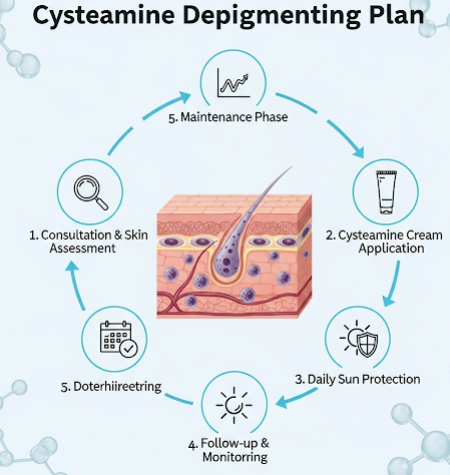
Cysteamine depigmenting therapy in Korea usually follows a stepwise protocol:
- Application phase
- Cysteamine cream is applied to pigmented areas for 15–30 minutes daily, then washed off.
- Some Korean dermatologists recommend gradual introduction (2–3 times per week at first).
- Combination therapies
- Often paired with laser toning (Pico or Nd:YAG) for deeper pigmentation.
- Oral or topical tranexamic acid may be added for resistant melasma.
- Light chemical peels can complement cysteamine for stubborn dark spots.
- Maintenance phase
- After 8–12 weeks of daily use, frequency may be reduced to 2–3 times per week.
- Continued sunscreen and gentle skincare maintain results.
→ Most patients notice visible improvement after 6–8 weeks, with optimal results by 3–4 months.
Recovery
Recovery with cysteamine therapy is generally smooth:
• Mild redness or tingling → Common during the first few weeks.
• Dryness or peeling → Managed with barrier creams.
• Visible lightening → Usually seen after 2 months of consistent use.
• Normal activities → No downtime; patients can continue work and social life.
→ Korean clinics often prescribe hydrating masks, calming serums, and LED light therapy to reduce irritation and accelerate recovery.
Complication
Though safer than hydroquinone, possible issues include:
- Irritation → Burning, itching, or redness if applied too long.
- Dryness → Especially in sensitive skin.
- Uneven results → If not applied consistently.
- Rebound pigmentation → Rare, but possible without sunscreen use.
→ Korean dermatologists minimize risks by starting with short contact times, adjusting frequency, and combining with hydrating regimens.
Treatment option in Korea
Korea offers advanced cysteamine depigmenting programs integrated into holistic pigmentation management:
→ Dermatology clinics → Provide prescription-grade cysteamine and tailor protocols for Korean and international patients.
→ Combination protocols → Frequently paired with Pico laser, chemical peels, and tranexamic acid.
• Barrier-friendly approach → Korean skincare philosophy emphasizes pairing cysteamine with soothing K-beauty products (centella, ceramides, hyaluronic acid).
• Digital monitoring → Clinics use imaging tools to track melanin reduction progress.
• Medical tourism → International patients visit Korea for safe, effective, and cosmetically refined melasma programs.
→ With its proven efficacy, safety profile, and integration with high-tech treatments, cysteamine depigmenting plans in Korea are an effective, patient-friendly solution for stubborn pigmentation.