What it is
Cryosurgery for actinic keratosis in Korea is a dermatological procedure that uses extreme cold (liquid nitrogen) to freeze and destroy precancerous skin lesions known as actinic keratoses (AKs).
Actinic keratosis appears as rough, scaly patches on sun-exposed areas such as the face, scalp, ears, and hands. If left untreated, some AKs may progress into squamous cell carcinoma.
→ Cryosurgery works by rapidly freezing AK cells, causing cell death and allowing the skin to regenerate with healthy tissue.
• Widely used in dermatology and skin cancer clinics across Korea.
• Considered the gold standard for quick, effective treatment of individual AK lesions.
Why it’s done
Patients in Korea undergo cryosurgery for actinic keratosis because:
→ Cancer prevention → Reduces the risk of progression into skin cancer.
→ Quick removal → Effective for single or small clusters of AKs.
→ Minimal downtime → Short healing period compared to surgery.
→ Cosmetic preservation → Important in Korea’s culture of aesthetics, as the treatment leaves minimal scarring.
→ Convenience → Often performed in a single outpatient visit.
Alternatives
Other treatment options for actinic keratosis include:
• Topical medications → 5-fluorouracil (5-FU), imiquimod, diclofenac gel, or ingenol mebutate.
• Photodynamic therapy (PDT) → Light-activated drugs target and destroy abnormal cells.
• Laser therapy → Fractional or ablative lasers for widespread AKs.
• Curettage → Scraping lesions with a surgical tool.
• Chemical peels → Trichloroacetic acid (TCA) or glycolic acid for broader resurfacing.
→ Cryosurgery is usually chosen for individual, well-defined lesions, while alternatives suit widespread or resistant AKs.
Preparation
Before undergoing cryosurgery in Korea, preparation steps include:
- Dermatology consultation → To confirm the lesion is an AK and not invasive cancer.
- Medical history review → Checks for cold intolerance, circulation problems, or keloid risk.
- Skin cleansing → Target area is disinfected before freezing.
- Patient education → Explanation of expected blistering, healing, and aftercare.
→ Korean clinics also use dermoscopy or digital imaging to precisely map lesion size before freezing.
How it’s done
Cryosurgery for AK in Korea is performed in a dermatology clinic as an outpatient procedure:
- Positioning → The patient is made comfortable, and the area is exposed.
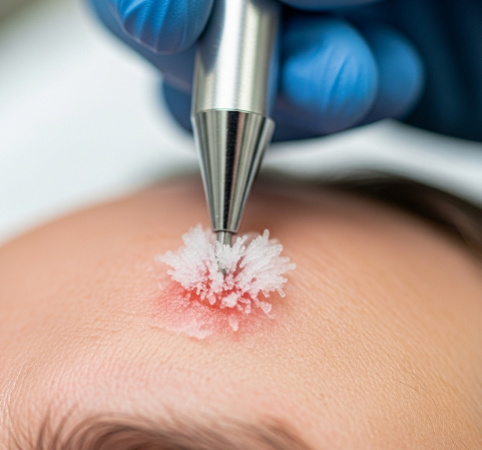
- Liquid nitrogen application
- Delivered with a cotton swab, cryoprobe, or spray device.
- Freezing lasts a few seconds to a minute, depending on lesion thickness.
- Freeze-thaw cycle
- The lesion is frozen, allowed to thaw, and sometimes re-frozen to ensure complete destruction.
- Dressing → Ointment and bandage may be applied if blistering is expected.
→ The session usually takes 5–15 minutes per lesion.
Recovery
Recovery after cryosurgery is usually fast and uncomplicated:
• Redness and swelling → Appear within hours, lasting 1–2 days.
• Blistering → Common and part of the healing process; resolves in 1–2 weeks.
• Crusting and shedding → Lesion falls off within 1–3 weeks, revealing new skin.
• Scar outcome → Usually minimal, with slight color change in some cases.
• Aftercare → Patients should apply ointment, avoid picking scabs, and use sunscreen to prevent recurrence.
→ Most patients resume normal activities immediately.
Complication
Possible side effects include:
- Pain or stinging → During freezing and immediately afterward.
- Pigment changes → Hypopigmentation (lighter spots) or hyperpigmentation (darker spots).
- Scarring → Rare but possible with deep freezes.
- Infection → Uncommon, but blister care is important.
- Recurrence → Some AKs may return, requiring repeat sessions.
→ Korean dermatologists minimize risks with precise freeze times and post-care support.
Treatment option in Korea
Korea offers advanced cryosurgery treatments for actinic keratosis:
→ Dermatology expertise → Performed by board-certified dermatologists trained in skin cancer care.
→ Modern cryosurgery devices → Spray and probe systems allow controlled freezing with minimal tissue damage.
• Cosmetic integration → Clinics often combine cryosurgery with lasers or scar-reducing treatments for better skin appearance.
• Follow-up care → Includes regular skin cancer screenings and preventive advice.
• Medical tourism → Korea’s reputation for aesthetic dermatology with cancer care precision attracts international patients.
→ With its high cure rate, cosmetic focus, and advanced technology, cryosurgery for actinic keratosis in Korea is one of the most effective and trusted methods for preventing skin cancer while preserving skin appearance.