What it is
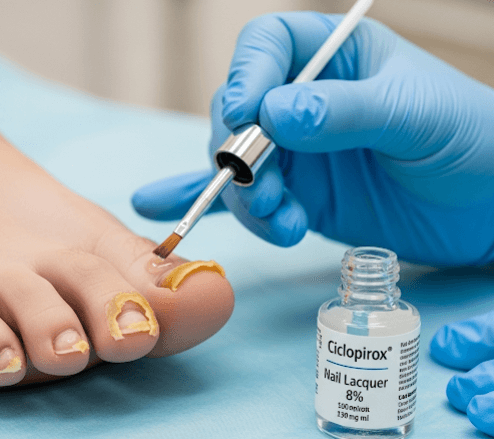
➝ Ciclopirox nail lacquer (usually 8%) is a topical antifungal treatment used for mild to moderate onychomycosis (fungal nail infection).
➝ Unlike systemic antifungals, ciclopirox works locally, penetrating the nail plate to kill fungi and prevent further growth.
➝ It is most effective in cases where the nail matrix (growth area) is not heavily involved and the infection affects less than 50% of the nail surface.
➝ In Korea, ciclopirox lacquer is often used as a first-line therapy for early infections or as adjunct therapy alongside oral antifungals or laser treatments.
Why it’s done
→ To treat fungal nail infections without systemic medication, avoiding risks to the liver and systemic side effects.
→ To manage patients who cannot take oral antifungals due to health conditions or drug interactions.
→ To provide maintenance therapy after systemic antifungals or laser treatment, reducing recurrence.
→ To improve nail appearance and hygiene over time.
→ In Korea, ciclopirox lacquer is widely prescribed in dermatology and podiatry clinics, often as part of a comprehensive onychomycosis program.
Alternatives
→ Other topical antifungals:
- Efinaconazole solution (often considered more effective but costlier).
- Amorolfine lacquer (not available everywhere).
→ Systemic antifungals: Terbinafine, itraconazole, fluconazole (more effective for moderate-to-severe infections).
→ Laser therapy: Nd:YAG or diode laser to improve drug penetration and fungal clearance.
→ Mechanical/chemical nail debridement: Filing, trimming, or urea-based keratolytics to thin the nail.
Preparation
→ Nails should be cleaned, trimmed, and filed down to reduce thickness before applying ciclopirox.
→ Patients are advised to avoid nail polish or cosmetic lacquers, as these block penetration.
→ Disinfection of nail tools, socks, and shoes is recommended to prevent reinfection.
→ In Korea, clinics often perform professional nail debridement/scaling before starting lacquer therapy, improving penetration and outcomes.
How it’s Done
→ Daily application: Ciclopirox is applied once daily to the entire affected nail, extending slightly to surrounding skin.
→ Weekly removal:
- Once a week, the lacquer is removed with alcohol or nail polish remover.
- The infected nail surface is filed down before reapplying fresh lacquer.
→ Duration:
- Fingernails: ~6 months.
- Toenails: ~9–12 months (due to slower growth).
→ Patients must be consistent and patient, as visible results take time while the healthy nail grows out.
→ In Korea, dermatologists often recommend combining ciclopirox lacquer with antifungal shampoo/foot care for best results.
Recovery
→ Early improvements in nail appearance may be seen in 2–3 months, but full clearance usually takes 6–12 months.
→ The nail gradually becomes clearer as new growth pushes out the infected part.
→ Patients experience better cosmetic results, improved comfort, and reduced embarrassment.
→ Long-term success depends on consistent use and proper foot/nail hygiene.
Complications
→ Local irritation: Redness, burning, or itching around the nail fold (rare).
→ Ineffectiveness in advanced disease: If more than 50% of the nail is affected or the nail matrix is involved, ciclopirox alone is unlikely to cure.
→ Reinfection risk: Without hygiene and preventive care, fungi can return even after successful treatment.
Treatment Options in Korea
→ Korean dermatology clinics frequently use ciclopirox nail lacquer as part of a stepwise treatment plan.
→ It is often combined with:
- Laser treatments to enhance penetration.
- Oral antifungals in moderate-to-severe infections (dual therapy).
- Professional nail debridement for better drug absorption.
→ Clinics emphasize patient education on:
- Proper daily application.
- Weekly removal and nail filing.
- Shoe/sock hygiene to prevent reinfection.
→ Many Korean clinics also provide photographic monitoring, showing patients nail progress over time to encourage adherence.
→ Overall, ciclopirox lacquer is valued in Korea as a safe, convenient, and effective treatment for mild cases and as maintenance or adjunct therapy in more severe infections.