What it is
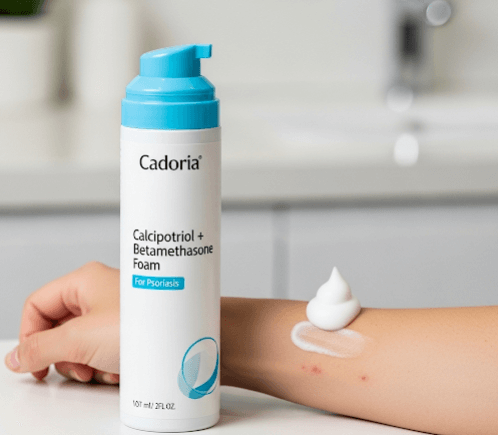
➝ Calcipotriol + Betamethasone foam is a topical combination treatment used for plaque psoriasis.
➝ Calcipotriol (a vitamin D analog) works by slowing down the overproduction of skin cells, which is one of the root causes of psoriasis plaques.
➝ Betamethasone (a potent corticosteroid) reduces inflammation, redness, itching, and scaling.
➝ When combined in foam form, the medication offers enhanced penetration, better adherence, and easier application compared to ointments or creams.
➝ It is widely used as a first-line topical treatment for mild-to-moderate psoriasis and as an adjunct therapy for more severe cases.
Why it’s done
→ To provide local control of psoriasis plaques without the risks of systemic medication.
→ Effective for scalp psoriasis, where foam spreads more easily than ointments.
→ Reduces symptoms quickly, improving comfort and appearance of the skin.
→ Often prescribed as a step-down therapy after systemic treatments or biologics to maintain remission.
→ In Korea, it is commonly used due to its efficacy, convenience, and strong safety profile compared to systemic drugs.
Alternatives
→ Other topical treatments:
- Corticosteroids alone (various potencies).
- Vitamin D analogs alone (calcipotriol ointment, tacalcitol).
- Coal tar preparations.
- Calcineurin inhibitors (tacrolimus, pimecrolimus – especially for sensitive areas).
→ Phototherapy: Narrowband UVB for mild to moderate disease.
→ Systemic options: Methotrexate, cyclosporine, acitretin, apremilast.
→ Biologics: Used in more severe or resistant cases.
Preparation
→ No special laboratory testing is needed before using calcipotriol + betamethasone foam.
→ Patients should be instructed on correct application technique to maximize effectiveness and minimize side effects.
→ Skin should be clean and dry before applying the foam.
→ Patients are usually advised not to use other strong topical steroids at the same site to avoid overdose.
→ In Korea, dermatologists often provide detailed patient education on safe use, especially for scalp applications.
How it’s Done
→ The foam is applied once daily, directly onto psoriasis plaques.
→ For scalp psoriasis, the foam spreads easily and absorbs quickly without leaving oily residue, which encourages adherence.
→ Duration of therapy is typically up to 4 weeks for continuous use, but can be extended under medical supervision for maintenance.
→ Patients should massage the foam gently into affected areas until it disappears.
→ Hands should be washed thoroughly after application.
Recovery
→ Patients often see improvement in redness, itching, and scaling within 1–2 weeks.
→ Significant plaque reduction usually occurs by 4 weeks of treatment.
→ Regular use helps achieve smoother skin and better control of localized flares.
→ Many patients report higher satisfaction with the foam formulation compared to ointments or gels due to ease of use.
→ For maintenance, dermatologists may recommend intermittent use to prevent flare-ups.
Complications
→ Mild side effects: Burning, itching, or irritation at the application site.
→ Steroid-related risks with long-term or excessive use:
- Skin thinning (atrophy).
- Stretch marks (striae).
- Telangiectasia (visible small blood vessels).
→ Vitamin D analog-related risks (rare in topical use): Changes in calcium levels if used excessively over large areas.
→ Safe when used as directed, especially compared to systemic medications.
Treatment Options in Korea
→ Widely prescribed by Korean dermatologists as a first-line topical therapy for localized plaque psoriasis.
→ Frequently used for scalp psoriasis, which is very common and often difficult to treat.
→ Korean clinics value the foam for its patient-friendly application, which improves adherence.
→ Often included in combination regimens:
- As an adjunct to phototherapy.
- Alongside systemic drugs to control localized resistant plaques.
- As maintenance after biologic therapy.
→ Patient education programs in Korea emphasize safe use of topical steroids, including application frequency, amount, and monitoring for side effects.
→ With Korea’s focus on comprehensive skin care, many clinics pair foam treatment with hydration therapy, moisturizers, and lifestyle advice for better long-term control.