What It Is
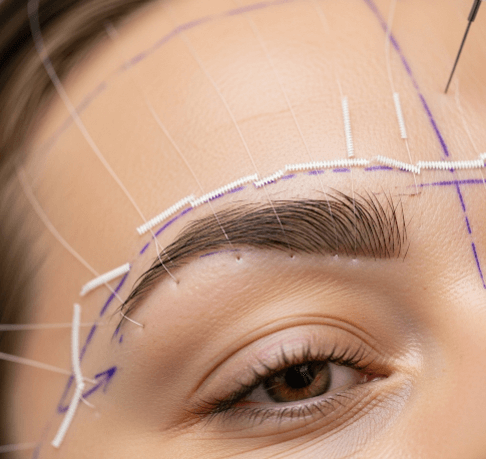
A Brow Lift Thread procedure is a non-surgical treatment that uses absorbable sutures — typically PDO (Polydioxanone), PLLA (Poly-L-Lactic Acid), or PCL (Polycaprolactone) — to lift and support sagging brows. The threads are inserted under the skin with fine cannulas and pulled to elevate the brow, creating a more youthful, open, and refreshed look.
This treatment:
- Provides an instant lift to drooping brows and eyelids.
- Stimulates collagen, elastin, and hyaluronic acid production for long-term tightening.
- Dissolves naturally within 6–36 months, depending on the thread type, leaving behind a collagen scaffold for sustained results.
In Korea, brow lift threads are a popular alternative to surgical brow lifts or blepharoplasty, especially for patients who want to achieve a natural, refreshed appearance without scars or downtime.
Why It’s Done
Patients undergo brow lift threads for both anti-aging and aesthetic goals:
➝ Correct drooping brows → Elevates sagging that makes eyes look heavy or tired.
➝ Smooth forehead and frown lines → Lifting reduces the appearance of wrinkles.
➝ Enhance eye shape → Creates a more open, refreshed, or almond-shaped look.
➝ Prevent hooded eyes → Lifts skin that causes eyelids to appear droopy.
➝ Non-surgical alternative → Safer, quicker, and less invasive than surgical lifts.
➝ Preventative care → Younger patients use it to maintain brow position and prevent sagging.
In Korean beauty culture, bright, youthful eyes and lifted brows are seen as central to facial attractiveness, which makes brow lift threads a widely requested treatment.
Alternatives
Brow lift threads are effective, but alternatives may also be considered:
- Botox brow lift → Temporarily elevates brows by relaxing forehead muscles.
- Dermal fillers → Add support in the temples for a subtle brow lift.
- PDO mono threads → Stimulate collagen but don’t provide strong lifting.
- PLLA or PCL threads → Offer stronger and longer-lasting lifting.
- HIFU (Shurink, Ultherapy) → Tightens the deeper SMAS layer, can support brow lifting.
- Thermage FLX (monopolar RF) → Tightens skin, improving elasticity.
- Surgical brow lift or blepharoplasty → Permanent solution for advanced sagging.
In Korea, brow lift threads are often combined with other treatments:
- Threads + Botox → Lifting plus smoothing wrinkles.
- Threads + Temple support → Provides structural support for outer brows.
- Threads + HIFU/Thermage → Mechanical lift plus collagen remodeling.
Preparation
Preparation ensures safety and long-lasting results:
➝ Consultation & facial mapping → Korean doctors often use digital analysis for planning.
➝ Medical history review → Patients disclose prior eyelid surgery, medications, and allergies.
➝ Avoid blood thinners → Stop aspirin, ibuprofen, or supplements 5–7 days before (with doctor’s guidance).
➝ No alcohol or smoking → For at least 48 hours before treatment.
➝ Skincare prep → Stop retinoids, acids, and harsh exfoliants 3–5 days before.
➝ Numbing → Local anesthesia is applied at insertion sites.
How It’s Done
A brow lift thread session usually takes 30–60 minutes:
- Cleansing & sterilization → The brow and temple area are disinfected.
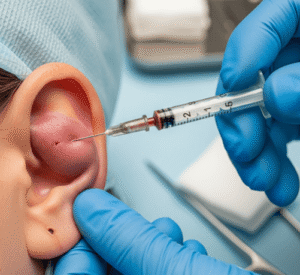
- Local anesthesia → Small numbing injections are applied.
- Thread insertion →
- Threads are inserted via blunt cannulas around the brow and temple.
- Barbed threads anchor into the skin to provide lifting.
- Adjustment → Threads are gently pulled to elevate the brows to the desired position.
- Trimming & finishing → Excess thread is cut, and cooling masks or LED therapy applied.
Treatment plan:
- One session → Provides immediate lifting and long-term collagen stimulation.
- Maintenance → PDO threads: 12–18 months; PLLA: 18–24 months; PCL: 24–36 months.
Recovery
Recovery is short compared to surgical brow lifts:
- Immediately after → Visible lifting; mild swelling or tightness.
- Day 1–7 → Bruising, tenderness, or dimpling possible.
- Week 2–3 → Threads settle; results become more natural.
- Month 1–3 → Collagen remodeling enhances lift and brow support.
- Month 6–12 → Best results appear, with smoother forehead and youthful eyes.
Aftercare tips:
➝ Avoid rubbing or pulling brows for 1–2 weeks.
➝ Sleep on your back with your head elevated for the first week.
➝ Use ice packs in the first 24 hours for swelling.
➝ Avoid saunas, alcohol, and heavy exercise for 1–2 weeks.
➝ Wear SPF 50+ sunscreen daily.
Korean clinics often provide soothing creams, antibiotics, and follow-up care.
Complications
Brow lift threads are safe but possible complications include:
➝ Bruising and swelling → Common, temporary.
➝ Skin dimpling or puckering → Resolves within weeks.
➝ Thread visibility → Rare, minimized with proper technique.
➝ Asymmetry → Can be adjusted if needed.
➝ Infection → Very rare with sterile conditions.
Korean dermatologists reduce risks by using FDA/KFDA-approved threads, precise mapping, and advanced insertion methods.
Treatment Options in Korea
Korea is a leading destination for thread lifts, with brow lifts being one of the most popular requests.
1. Types of Threads Used
- PDO threads → Affordable, collagen-stimulating, last 12–18 months.
- PLLA threads → Stronger lifting, last 18–24 months.
- PCL threads → Premium, longest-lasting, up to 36 months.
Final Thoughts
Brow Lift Threads in Korea are a highly effective, minimally invasive solution for patients who want lifted brows, youthful eyes, and smoother foreheads without undergoing surgery. With absorbable PDO, PLLA, or PCL threads, the procedure provides instant lifting and long-term collagen regeneration.
Korean clinics excel in customizing brow lifts to each patient, often combining them with temple support, fox eye lifts, Botox, or HIFU for natural yet noticeable results. For anyone seeking a refreshed, youthful, and balanced upper face, brow lift threads in Korea are one of the most advanced options worldwide.