What it is
➝ Alginate dressings are advanced wound care materials derived from seaweed (alginic acid salts).
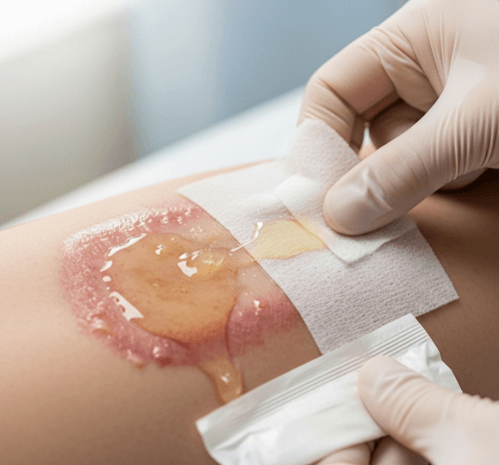
➝ When placed in contact with wound exudate, they form a soft gel-like substance that helps absorb fluid, maintain a moist environment, and promote healing.
➝ They are particularly suited for moderate to heavily exudative wounds, including pressure ulcers, venous leg ulcers, diabetic foot ulcers, cavity wounds, and post-surgical wounds.
➝ In Korea, alginate dressings are commonly used in specialized wound care centers, diabetic foot clinics, and hospital surgical units, often as part of comprehensive wound management.
Why it’s done
→ To effectively manage excessive wound exudate, preventing maceration of surrounding skin.
→ To promote faster granulation tissue formation and wound closure.
→ To minimize dressing change frequency, since alginate can absorb large amounts of fluid.
→ To reduce infection risk, as the gel forms a protective barrier against bacteria.
→ In Korea, alginate dressings are preferred for deep, cavity-type wounds where fluid buildup delays healing.
Alternatives
→ Foam dressings: absorbent, but less effective for cavity wounds.
→ Hydrocolloid dressings: best for low to moderate exudate, not heavy drainage.
→ Hydrogel dressings: suitable for dry wounds, not exudative ones.
→ Conventional gauze: inexpensive, but requires frequent changes and can adhere painfully to wound bed.
Preparation
→ Assess wound depth, exudate level, and presence of infection.
→ Cleanse wound with sterile saline or wound cleanser.
→ Debride necrotic tissue if present before dressing application.
→ In Korea, wound care teams often use digital wound measurement tools before and during alginate therapy to track healing progress.
How it’s Done
→ Cut alginate dressing to fit wound shape and size.
→ Place directly into wound bed; for deep wounds, gently pack without overfilling.
→ Cover with a secondary dressing (foam or film) to secure in place.
→ Change dressing every 1–3 days, depending on exudate volume.
→ Remove by irrigating with saline; alginate gel lifts easily without trauma.
→ In Korean clinics, alginate dressings are often alternated with antimicrobial dressings (e.g., silver alginate) in infected wounds.
Recovery
→ Wounds typically show reduced exudate and improved granulation within 1–2 weeks.
→ Healing rates improve compared to gauze-based dressings, especially in diabetic ulcers and pressure sores.
→ Patients experience less pain on dressing removal due to the gel-like consistency.
→ Long-term outcomes include faster healing and lower infection rates.
Complications
→ Over-drying if used on wounds with minimal exudate.
→ Maceration of surrounding skin if not paired with protective barrier cream.
→ Ineffective in dry or necrotic wounds without sufficient fluid.
→ Rare cases of adhesive allergy from secondary dressing.
Treatment Options in Korea
→ Korean wound care clinics routinely use alginate dressings for heavily exudative wounds such as diabetic foot ulcers, venous stasis ulcers, and infected surgical wounds.
→ Silver-impregnated alginate dressings are widely available in Korea and preferred for wounds with signs of infection.
→ Hospitals combine alginate therapy with negative-pressure wound therapy (NPWT) for deep cavity wounds.
→ Korean diabetic clinics integrate alginate dressing into multidisciplinary programs (endocrinology, vascular surgery, podiatry) for better outcomes.
→ Pharmacies in Korea also stock alginate dressings for outpatient wound care, making them accessible beyond hospital settings.