What It Is
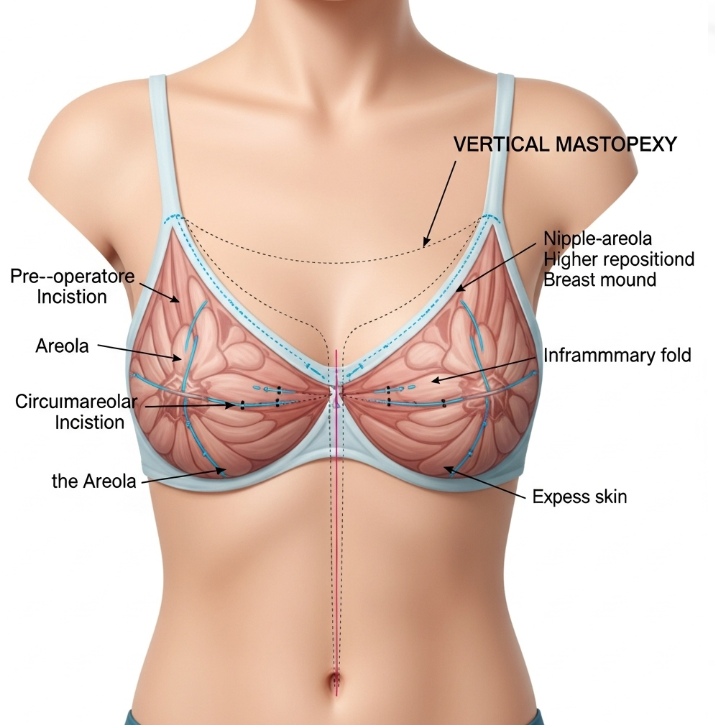
Vertical mastopexy, also known as a “lollipop lift”, is a breast lift technique used to correct moderate sagging (ptosis). The procedure removes excess skin, reshapes the breast tissue, and repositions the nipple-areola complex to achieve a firmer, youthful breast contour.
The vertical technique uses an incision around the areola and a vertical line down to the breast crease, resembling a lollipop shape. In Korea, surgeons often combine vertical mastopexy with implants or fat transfer for patients who want both lift and added volume.
Why It’s Done
Patients undergo vertical mastopexy because:
- Their breasts show moderate drooping that cannot be corrected with a periareolar lift alone.
- The nipples point downward or sit below the breast crease.
- They want improved projection and firmness without the more extensive scars of a full anchor lift.
- They may want to correct asymmetry or stretched areolas.
Good candidates include:
- Women in good health with moderate sagging and adequate breast tissue.
- Patients who prefer a balance between effective lifting and minimal scarring.
- Those who may also want augmentation with implants or fat grafting.
Alternatives
- Periareolar mastopexy: Suitable only for mild sagging.
- Anchor (inverted-T) mastopexy: Required for severe sagging.
- Breast implants or fat transfer alone: Provide volume but do not adequately lift sagging tissue.
- Non-surgical methods: Bras or skin-tightening treatments, but these do not provide permanent results.
Preparation
Before vertical mastopexy in Korea, patients will:
- Undergo breast measurements, 3D simulations, and imaging if needed.
- Discuss incision patterns, scar placement, and potential combination with implants.
- Stop smoking and alcohol 2–4 weeks before surgery.
- Avoid blood-thinning medications and certain supplements.
- Plan for recovery time and arrange follow-up visits.
How It’s Done
- Anesthesia: General anesthesia is typically used.
- Incisions: Made around the areola and vertically down to the breast crease.
- Reshaping: Excess skin is removed, breast tissue is lifted and reshaped, and the nipple-areola complex is repositioned.
- Closure: Sutures are placed, with attention to scar minimization.
- Duration: 2–3 hours, usually outpatient.
Recovery
- First week: Swelling, bruising, and soreness are common; a support bra is worn continuously.
- Stitches: Dissolvable or removed within 7–10 days.
- Return to activities: Light duties after 5–7 days; no strenuous exercise for 4–6 weeks.
- Final results: Breasts appear lifted, firmer, and more proportionate within 2–3 months. Scars typically fade over 6–12 months.
Possible Complications
- Vertical scarring, though less extensive than anchor technique.
- Asymmetry between breasts.
- Temporary or permanent changes in nipple sensation.
- Infection or delayed healing.
- Rare risks: recurrence of sagging or need for revision surgery.
Treatment Options in Korea
Diagnosis
Korean surgeons use 3D breast analysis, clinical examination, and imaging (if necessary) to assess the degree of sagging and determine suitability for vertical mastopexy.
Medical Treatments
- Non-surgical options such as supportive bras or mild tightening procedures for very early sagging.
Surgical or Advanced Therapies
- Vertical mastopexy for moderate sagging.
- Combination with implants or fat transfer for lift + volume.
- Anchor mastopexy for severe cases where more skin removal is required.
- Revisional mastopexy for patients with prior unsatisfactory outcomes.
Rehabilitation and Support
- Scar care using silicone sheets, gels, or fractional laser therapy.
- Lifestyle guidance to maintain results (weight stability, supportive bras).
- Regular long-term follow-up to ensure lasting results.
- International patients benefit from Korea’s breast surgery expertise, scar-minimizing techniques, and comprehensive aftercare programs.