What It Is
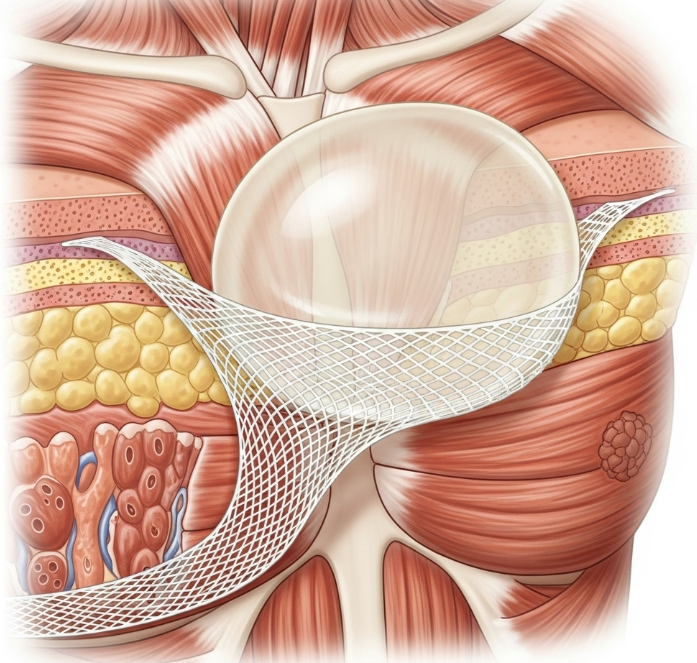
An acellular dermal matrix (ADM) sling is a surgical technique used in breast reconstruction and revision surgery to provide additional support and coverage for breast implants. ADM is a biologic mesh made from processed human or animal skin with all cells removed, leaving behind a collagen framework that integrates with the patient’s own tissue.
In Korea, ADM slings are widely used in implant-based breast reconstruction (such as prepectoral placement) and in revision surgeries for implant malposition, capsular contracture, or rippling. They act as an internal hammock or sling to hold implants securely in place, improve contour, and reduce complications.
Why It’s Done
Patients undergo ADM sling procedures because:
- They need extra support for implants after mastectomy or reconstruction.
- They want to prevent or correct implant malposition, bottoming out, or lateral displacement.
- ADM reduces the risk of capsular contracture and improves implant coverage.
- It enhances breast contour, especially in thin-skinned patients.
Good candidates include:
- Women undergoing implant-based breast reconstruction after mastectomy.
- Patients with recurrent implant complications needing revision surgery.
- Individuals with thin tissue coverage who require reinforcement.
Alternatives
- Synthetic mesh: Artificial materials that provide structural support but may not integrate as naturally.
- Autologous tissue flaps: Use of patient’s own tissue (e.g., DIEP flap), though more invasive.
- Fat grafting: Improves contour but offers less structural support compared to ADM.
Preparation
Before ADM sling placement in Korea, patients will:
- Undergo consultation and imaging (ultrasound, MRI) to assess tissue and implant condition.
- Stop smoking and alcohol 4 weeks before surgery.
- Avoid blood-thinning medications and supplements.
- Discuss reconstruction or revision goals, implant size, and pocket placement.
How It’s Done
- Anesthesia: General anesthesia is used.
- Pocket preparation: The implant pocket is opened or newly created (prepectoral or submuscular).
- ADM placement: The ADM is shaped and sutured to the chest wall and surrounding tissue, creating a hammock-like sling.
- Implant insertion: The implant is placed within the reinforced pocket.
- Closure: Sutures and dressings applied; drains may be placed.
- Duration: 2–4 hours depending on complexity.
Recovery
- First week: Swelling, bruising, and mild discomfort are common.
- Hospital stay: 2–5 days depending on the extent of surgery.
- Return to activities: Light activities in 1–2 weeks; strenuous exercise avoided for 4–6 weeks.
- Final results: Stable, natural breast contour within 2–3 months.
Possible Complications
- Seroma (fluid collection).
- Infection or rejection of ADM (rare with modern products).
- Implant malposition if integration is incomplete.
- Visible scarring, though minimized with Korean techniques.
- Rare risks: delayed healing or recurrence of capsular contracture.
Treatment Options in Korea
Diagnosis
Korean surgeons use 3D breast imaging, ultrasound, and MRI to assess tissue thickness, implant position, and suitability for ADM.
Medical Treatments
- Support bras and massage therapy for mild implant displacement (limited effect).
Surgical or Advanced Therapies
- ADM sling for implant reconstruction (prepectoral or submuscular).
- ADM reinforcement in revision surgery for recurrent capsular contracture or malposition.
- Hybrid approaches with fat grafting to improve contour and natural feel.
- Nipple-areola reconstruction and tattooing as part of final-stage refinement.
Rehabilitation and Support
- Scar care with silicone gels or fractional laser.
- Long-term follow-up to monitor ADM integration and implant stability.
- Guidance on supportive bras to maintain results.
- International patients benefit from Korea’s advanced use of ADM, microsurgical expertise, and comprehensive aftercare programs.