What It Is
The areola top-hat lift is a specialized breast lift technique that focuses on reshaping and lifting the breast by tightening the skin around the areola. This method is often chosen when patients need a subtle lift or correction of mild sagging without the full scarring of traditional mastopexy.
The technique is called “top-hat” because the incision is typically made around the areola and slightly above it, allowing surgeons to lift and reshape the breast while maintaining a natural look and minimizing visible scars. In Korea, this procedure is often combined with breast augmentation or fat grafting for enhanced results.
Why It’s Done
Patients undergo an areola top-hat lift because:
- They have mild breast sagging (ptosis).
- They want to improve the position and projection of the nipple–areola complex.
- They prefer a less invasive lift with fewer scars.
- It can correct asymmetry or changes after breastfeeding, weight loss, or aging.
Good candidates include:
- Patients with mild to moderate ptosis.
- Women who want perkier breasts without a full breast lift.
- Those in good health with realistic expectations about scarring and results.
Alternatives
- Periareolar (donut) lift: Similar but limited in its ability to lift.
- Vertical mastopexy: For moderate sagging with a lollipop-shaped incision.
- Full (anchor) mastopexy: For severe sagging requiring extensive correction.
- No treatment: For patients who accept natural breast shape.
Preparation
Before an areola top-hat lift in Korea, patients will:
- Have a breast exam, photography, and surgical planning.
- Stop smoking and alcohol 2–4 weeks before surgery.
- Avoid blood-thinning medications and certain supplements.
- Discuss whether the lift should be combined with implants or fat grafting.
How It’s Done
- Anesthesia: General anesthesia or local with sedation.
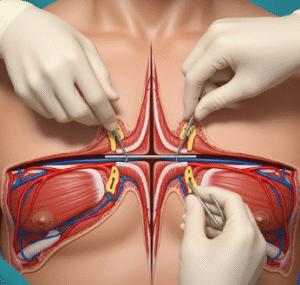
- Incision: Circular incision around the areola, sometimes extending slightly above it (the “top-hat” shape).
- Tissue adjustment: Skin is tightened, and the nipple–areola complex is repositioned slightly higher.
- Closure: Fine sutures are used to minimize scarring.
- Duration: 1–2 hours, usually outpatient.
Recovery
- First week: swelling, mild bruising, and soreness.
- Stitches may dissolve or be removed within 7–10 days.
- Most patients return to work in 5–7 days, but strenuous activity is avoided for 3–4 weeks.
- Final breast shape and scar fading occur over 3–6 months.
Possible Complications
- Scarring around the areola (usually well hidden).
- Asymmetry or uneven nipple placement.
- Changes in nipple sensation (temporary or permanent).
- Infection or delayed wound healing.
- Rare risks: flattening of breast shape if too much skin is removed.
Treatment Options in Korea
Diagnosis
- Breast evaluation with physical examination and imaging if needed.
- 3D simulation for planning nipple position and overall breast shape.
Surgical Treatments
- Areola top-hat lift alone for mild sagging.
- Combination with breast augmentation (implants or fat grafting) for volume enhancement.
- Asymmetry correction if one breast is more ptotic than the other.
- Revision lift for patients who have had prior breast surgery with unsatisfactory results.
Rehabilitation and Support
- Use of a supportive surgical bra during recovery.
- Scar care with silicone gels, laser therapy, or microneedling if needed.
- Follow-up visits for symmetry checks and scar assessment.
- International patients benefit from Korea’s refined scar-minimizing techniques, advanced surgical planning, and natural results approach.