What it is
Dupilumab for atopic dermatitis in Korea is a modern biologic therapy used to treat moderate-to-severe atopic dermatitis (AD) that does not respond well to conventional topical or systemic treatments.
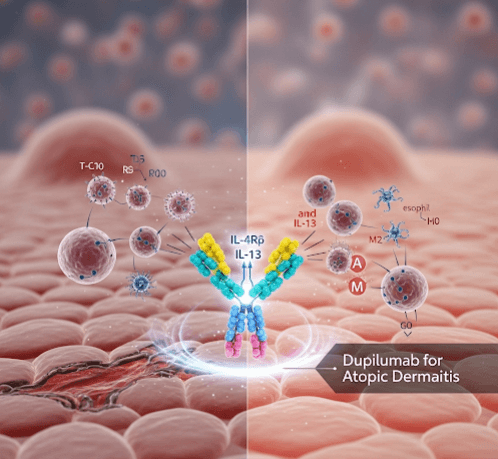
Dupilumab is a monoclonal antibody that targets IL-4 receptor alpha, blocking the signaling of interleukin-4 and interleukin-13, two key drivers of inflammation in atopic dermatitis.
→ By inhibiting these pathways, dupilumab reduces itch, inflammation, skin barrier disruption, and flare frequency.
• In Korea, dupilumab is widely available in dermatology hospitals, allergy clinics, and immunology centers.
• Considered one of the most effective and safe systemic options for long-term eczema control.
Why it’s done
Patients in Korea are prescribed dupilumab for:
→ Moderate-to-severe AD → When topical steroids, calcineurin inhibitors, or phototherapy are insufficient.
→ Chronic flare control → Reduces need for oral corticosteroids or cyclosporine.
→ Itch relief → Provides rapid and significant reduction of eczema-associated itching.
→ Sleep improvement → Improves quality of life for patients with nighttime itching.
→ Steroid-sparing effect → Allows patients to reduce or discontinue strong steroid use.
Alternatives
Other systemic treatments for atopic dermatitis include:
• Cyclosporine, methotrexate, azathioprine, mycophenolate → Traditional immunosuppressants, with more side effects.
• Phototherapy (NB-UVB, UVA1) → Effective for widespread AD.
• JAK inhibitors (baricitinib, upadacitinib, abrocitinib) → Oral targeted therapies increasingly available in Korea.
• Topical therapies → Corticosteroids, calcineurin inhibitors, PDE4 inhibitors for mild-to-moderate AD.
→ Dupilumab is preferred for long-term systemic control with fewer systemic risks compared to older immunosuppressants.
Preparation
Before starting dupilumab in Korea, preparation involves:
- Dermatology consultation → Assessment of AD severity, history of flares, and prior treatments.
- Baseline tests → Bloodwork may be performed to check overall health, though dupilumab generally does not require intensive lab monitoring.
- Allergy evaluation → Some clinics integrate allergy and asthma testing, since dupilumab also helps these conditions.
- Patient education → Training on self-injection technique, expected timeline of improvement, and potential side effects.
- Lifestyle counseling → Ongoing skincare and trigger avoidance emphasized.
→ Korean dermatologists often combine digital eczema severity scoring and photography to track treatment progress.
How it’s done
Dupilumab therapy in Korea follows an injection-based protocol:
- Initial loading dose → Two subcutaneous injections (600 mg total).
- Maintenance dose → 300 mg every 2 weeks via self-injection pen or prefilled syringe.
- Administration sites → Abdomen, thigh, or upper arm.
- Adjunct therapy → Patients continue moisturizers, mild steroids, or calcineurin inhibitors as needed.
- Follow-up visits → Every 1–3 months to monitor clinical response and side effects.
→ Many Korean clinics train patients for at-home self-administration after the first few supervised doses.
Recovery
Response to dupilumab is often rapid and sustained:
• Itch reduction → Noticeable within 1–2 weeks.
• Skin improvement → Redness, scaling, and lichenification improve within 4–8 weeks.
• Long-term stability → Many patients achieve sustained remission with continuous use.
• Quality of life → Sleep, mood, and daily functioning improve significantly.
• Maintenance therapy → Most patients stay on dupilumab long-term for control.
→ Korean patients often pair dupilumab with skin barrier–repair programs (ceramide creams, hydrating facials) for added benefit.
Complication
Dupilumab is generally safe, but possible side effects include:
- Injection site reactions → Redness, swelling, or pain.
- Conjunctivitis or eye irritation → Common in some patients, often managed with ophthalmic drops.
- Blepharitis (eyelid inflammation) → Possible but usually mild.
- Eosinophilia → Rare increase in white blood cells, usually without symptoms.
- Allergic reactions → Very rare.
→ In Korea, dermatologists collaborate with ophthalmologists when eye-related side effects occur, ensuring full multidisciplinary care.
Treatment option in Korea
Korea provides advanced dupilumab programs for atopic dermatitis:
→ Dermatology hospitals and allergy centers → Experienced in biologic therapies for AD.
→ Patient-centered protocols → Self-injection training, monitoring apps, and lifestyle guidance.
• Combination with holistic care → Moisturization, wet-wraps, phototherapy, and probiotics often included.
• Cutting-edge alternatives → JAK inhibitors available for patients not suited to dupilumab.
• Medical tourism → International patients choose Korea for fast access, expert dermatologists, and integrated skincare programs.
→ With its high efficacy, safety profile, and long-term disease control, dupilumab for atopic dermatitis in Korea represents a breakthrough therapy for patients struggling with chronic, severe eczema.