🟢 What it is
Minoxidil therapy in Korea is one of the most widely used treatments for androgenetic alopecia (pattern hair loss) in both men and women. Minoxidil works as a vasodilator, improving blood circulation in the scalp, extending the anagen (growth) phase of the hair cycle, and stimulating follicles to produce thicker and stronger hair.
Minoxidil can be prescribed as:
- Topical solution or foam (2% or 5%) applied to the scalp.
- Oral low-dose minoxidil (LDOM), which has become increasingly popular in Korean dermatology clinics for patients who cannot tolerate or do not respond well to topical use.
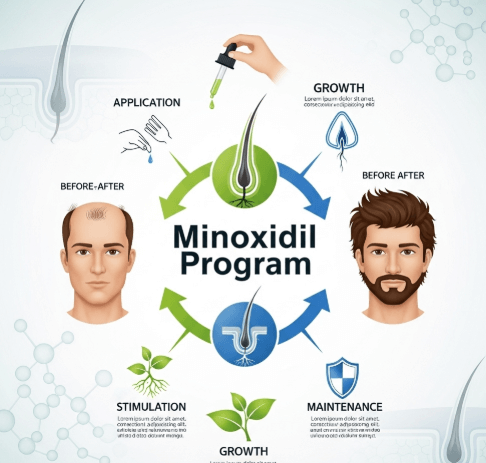
In Korea, minoxidil is often structured as a long-term “program” that includes medical supervision, scalp care, and sometimes combination therapies with PRP, exosomes, or mesotherapy.
🟢 Why it’s Done
Patients in Korea use minoxidil therapy for:
➡️ Androgenetic alopecia (male/female pattern hair loss): Slows progression and stimulates regrowth.
➡️ Diffuse thinning: Improves density and hair shaft thickness.
➡️ Postpartum hair loss: Speeds recovery after pregnancy-related shedding.
➡️ Adjunct therapy: Used with finasteride, dutasteride, or hair transplants.
➡️ General hair strengthening: Improves scalp blood flow and follicle activity.
🟢 Alternatives
If minoxidil alone isn’t enough, Korean doctors may suggest:
🔹 Finasteride (oral/topical): DHT blocker for men.
🔹 Dutasteride: Stronger DHT blocker, for advanced hair loss.
🔹 PRP (Platelet-Rich Plasma): Growth factor injections from the patient’s own blood.
🔹 Exosome scalp therapy: Advanced regenerative boosters.
🔹 Scalp mesotherapy: Nutrients, HA, peptides for follicle health.
🔹 Regenera Activa: Autologous micro-grafts for follicle regeneration.
🔹 Hair transplant (FUE/FUT): For severe baldness not manageable with medications.
🟢 Preparation
Before starting a minoxidil program, Korean clinics typically require:
➡️ Scalp and hair analysis: Using dermatoscope to check follicle activity.
➡️ Medical history review: Cardiovascular health (since minoxidil affects blood vessels), medications, allergies.
➡️ Patch test (for topical): To rule out irritation or allergy.
➡️ Expectation setting: Results are gradual, requiring continuous use.
🟢 How it’s Done
🔹 Topical Minoxidil
- Applied twice daily (2% or 5% solution/foam).
- Focused on thinning areas (crown, temples, or diffuse scalp).
- Visible results after 3–6 months.
🔹 Oral Low-Dose Minoxidil (LDOM)
- Prescribed under medical supervision in Korea (usually 0.25–2.5 mg daily).
- Used for patients intolerant to topical minoxidil or seeking more systemic results.
- Requires monitoring for side effects (blood pressure, fluid retention, unwanted hair growth).
🔹 Korean Minoxidil “Programs”
Many dermatology clinics in Korea package minoxidil therapy with:
- Scalp scaling & detox treatments (to improve absorption).
- LED or laser therapy (to boost circulation).
- Adjunct injectables (PRP, exosomes, PN boosters).
- Regular follow-ups every 2–3 months to monitor progress.
🟢 Recovery
No downtime, but adaptation is key:
🔹 Topical:
- Mild irritation, dryness, or itching may occur.
- Early “shedding phase” in first 2–6 weeks as weak hairs fall before stronger ones regrow.
🔹 Oral (LDOM):
- Mild water retention or body hair growth possible.
- Rare cases of low blood pressure or dizziness, usually managed by dose adjustment.
🔹 Results:
- Noticeable reduction in shedding at 2–3 months.
- Visible thickening and regrowth at 4–6 months.
- Peak effects after 12 months of continuous use.
🟢 Complications
⚠️ Topical minoxidil side effects:
- Scalp dryness, itching, or irritation.
- Unwanted facial hair growth (if solution drips).
⚠️ Oral minoxidil side effects:
- Fluid retention (swollen ankles, puffy eyes).
- Increased body hair growth (hypertrichosis).
- Low blood pressure or dizziness (rare).
- Heart palpitations (very rare, dose-dependent).
➡️ In Korea, dermatologists minimize risks by tailoring dosage, combining therapies, and monitoring patients closely.
🟢 Treatment Options in Korea
Korean hair restoration clinics use minoxidil in different ways:
🔹 Standalone topical therapy: For early hair loss or maintenance.
🔹 Oral low-dose minoxidil program: For patients seeking stronger results.
🔹 Combination therapy:
- Minoxidil + Finasteride/Dutasteride → Gold standard for men.
- Minoxidil + PRP/Exosomes → Vascular stimulation + regenerative repair.
- Minoxidil + Hair Transplant → Supports graft survival and prevents further loss.
🔹 Korean program approach:
- Monthly scalp care treatments.
- Medications + injectables + home-care products.
- Long-term maintenance schedules.
🟢 Final Thoughts
Minoxidil programs in Korea are a fundamental part of hair loss treatment, offering both topical and oral options under medical supervision.
➡️ Best for patients with early to moderate hair loss, postpartum shedding, or diffuse thinning.
➡️ Requires patience and consistency—results appear after months, not weeks.
➡️ With Korea’s integrated approach (medication + regenerative therapies + scalp care), minoxidil therapy is more effective and sustainable than standalone use.
In summary: Minoxidil programs in Korea are a safe, customizable, and clinically proven way to stimulate hair growth and prevent further loss—especially when combined with other advanced Korean hair restoration protocols.